Welcome to Guilin HCM Machinery Official WebSite!
Welcome to Guilin HCM Machinery Official WebSite!

Release date: 2026-11-01 14:32:29
At Guilin Hongcheng (HCM), we develop grinding solutions for non-metallic mineral processing, including calcium carbonate production from raw materials such as calcite and marble. Our project references cover different production scales and fineness requirements. This experience allows us to approach each project according to its specific technical requirements rather than applying a single configuration to every plant.
A conventional ground calcium carbonate (GCC) production line typically consists of several stages: raw material crushing, feeding, grinding, classification, powder collection, and finished product conveying.
The configuration of these systems must be adapted to the target product. A plant producing calcium carbonate for conventional applications does not necessarily have the same requirements as a production line designed for ultrafine powder used in coatings and other industrial applications. Equipment selection should therefore begin with the product specifications, rather than focusing solely on the mill model.
HCM offers different grinding solutions for non-metallic mineral processing, including HLM series vertical roller mills, HLMX series ultrafine vertical mills, and HCH series ultrafine ring roller mills.
The appropriate equipment depends on the combination of target fineness, production capacity, and feed material conditions required by each project. For conventional products, the mill should be selected according to the target particle size and expected output. When the market requires ultrafine products, particular attention must be paid to grinding and classification capacity to achieve the specified particle size distribution.
HLMX ultrafine vertical mills are designed for industrial-scale ultrafine powder processing. When selecting this equipment for a calcium carbonate grinding plant, both the required output and final fineness, as well as the characteristics of the raw material, must be taken into account.
However, installing a larger mill does not automatically guarantee better results. The feeding, classification, dust collection, and conveying systems must also be properly sized to meet the requirements of the complete production line.
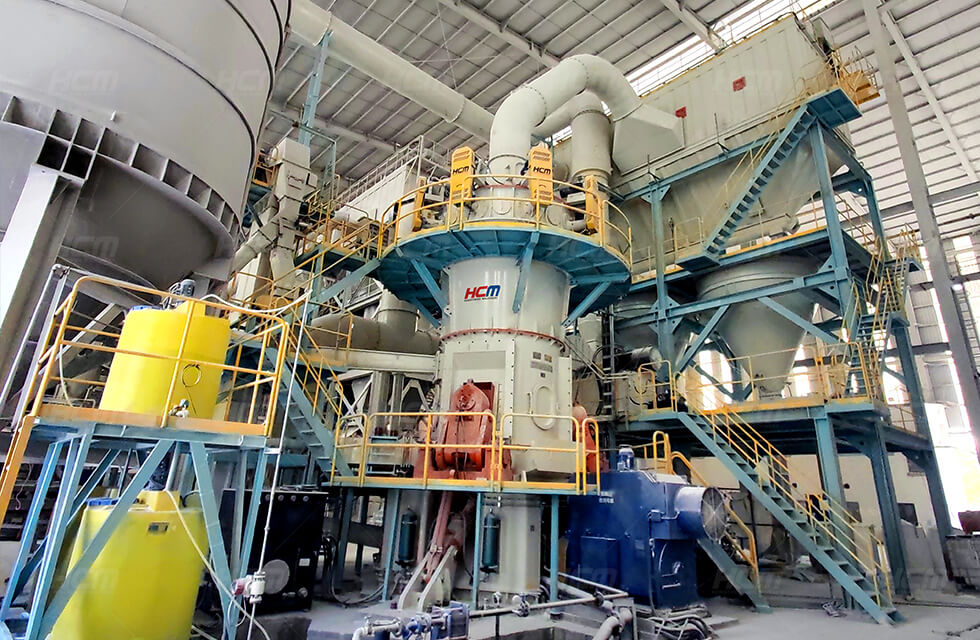
HCM's project references provide practical examples of how plant configurations can vary according to different production requirements.
In Nanzhao, Henan Province, HCM supplied an HLMX1300 ultrafine vertical mill for calcite processing. According to the published project information, the target fineness is 1250 mesh, with an approximate annual production of 30,000 tons.
This project serves as a reference for companies considering a calcite grinding line for ultrafine calcium carbonate production. To assess whether a similar configuration is suitable for another plant, the product specifications, raw material characteristics, and expected operating conditions must also be evaluated.
In another HCM project in Hubei, an HLMX1300 ultrafine vertical mill was installed to produce 800-mesh calcite powder. The published case information indicates an annual production of 40,000 tons.
Although both projects use the HLMX1300 model, their target fineness and annual production figures are different. This highlights the importance of evaluating the specific conditions of each production line. The published data alone are not sufficient to attribute the difference in output solely to fineness, as operating hours, material characteristics, and other operating parameters may also play a role.
In Shimian, Sichuan Province, HCM participated in a project equipped with two HLMX1700 ultrafine vertical mills. According to the official project information, the raw material is marble, the product fineness ranges from 600 to 2000 mesh, and the planned annual production is 400,000 tons.
The project is designed to supply calcium carbonate for a range of applications, including coatings, rubber, plastics, daily-use chemicals, nonwoven fabrics, and artificial stone.
For this type of installation, equipment selection must take into account both the production scale and the range of particle size specifications required. The final configuration of a new plant should be evaluated based on its own operating conditions, rather than directly applying the results of this project to another site.
The actual output of a grinding plant depends on several interrelated factors.
Product fineness. The required particle size determines the selection of the grinding mill and classification system. For ultrafine products, the proposed configuration must be evaluated to ensure that it can meet the buyer's specifications.
Raw material characteristics. Mineral composition, moisture content, feed particle size, and grindability should be assessed before determining the plant configuration. Differences in raw materials can affect the grinding process.
Production capacity. Annual production is not the same as the mill's instantaneous capacity. Estimating a plant's output also requires information about operating hours, system availability, and operating conditions.
Auxiliary equipment. Feeding, classification, dust collection, and conveying systems are all integral parts of a grinding production line. Their capacity and configuration must match the material flow rate and final product requirements.
In addition to production output, it is advisable to evaluate specific energy consumption, wear part consumption, and product quality stability. These indicators should be compared under defined operating conditions. They cannot be reliably inferred from the mill model or the published annual production of another project alone.
Before selecting equipment, customers should define the available raw material, required fineness, expected hourly and annual production, and final product quality specifications. It is also important to clarify the intended applications, site conditions, and requirements for product storage and conveying.
With this information, the most suitable grinding technology and the necessary auxiliary systems can be evaluated. When an application requires ultrafine powder, particular attention should be paid to the combination of grinding and classification, as well as the system's ability to consistently meet the specified product requirements.
At HCM, we select grinding equipment and develop plant configurations based on the specific requirements of each project. Our projects in Nanzhao, Hubei, and Sichuan demonstrate real-world applications of HLMX mills for calcium carbonate production under different operating and product requirements. These references can serve as a starting point for technical evaluation, but the final equipment selection must be based on the actual conditions of each installation.
If you are planning a calcium carbonate grinding plant, clearly defining your raw material, target fineness, and required production capacity is the first step toward evaluating a suitable grinding and classification solution.
