Welcome to Guilin HCM Machinery Official WebSite!
Welcome to Guilin HCM Machinery Official WebSite!

Release date: 2026-11-19 10:41:35
When discussing a dolomite grinding mill, product fineness is often expressed using mesh numbers. However, a specification such as 325 mesh D97 provides more information than a mesh value alone. Understanding how these terms describe powder fineness helps manufacturers communicate product requirements and evaluate grinding results.
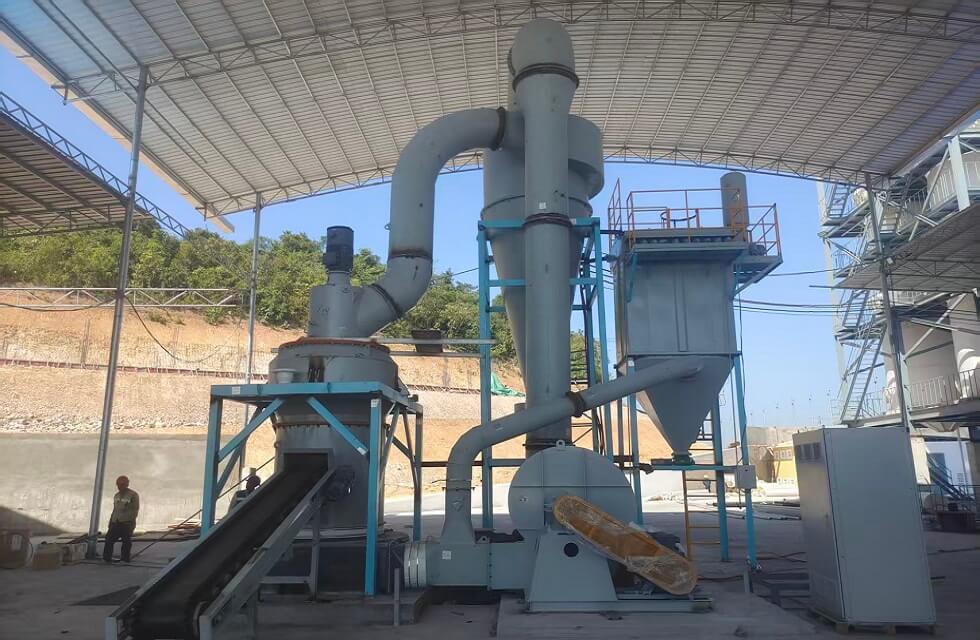
At HCM, we have applied our HC1300 Raymond mill to a dolomite powder production project with a finished product specification of 325 mesh D97 and a production capacity of 8–10 t/h. This project provides a practical reference for understanding how fineness requirements relate to actual grinding performance.
Mesh size and D97 are related to particle fineness, but they describe it from different perspectives.
Mesh refers to the number of openings per linear inch in a sieve. A higher mesh number generally indicates smaller sieve openings and finer material.
D97 is a particle-size distribution parameter. It identifies the particle size below which 97% of the measured particle distribution falls. This makes it useful when describing the overall fineness of a powder rather than relying on a single sieve designation.
Consequently, mesh and D97 should not be treated as interchangeable units. When a buyer specifies 325 mesh D97, the required product specification should be understood as a whole. The measurement method and acceptance criteria also need to be clear when confirming product quality.
For dolomite powder manufacturers, defining the target fineness accurately is an important step before selecting grinding equipment.
Dolomite is a carbonate mineral used in building materials, ceramics, glass, refractory materials, chemical production, agriculture and environmental applications. Different production requirements can call for different powder specifications.
HCM's dolomite processing reference divides grinding requirements into three fineness ranges:
80–400 mesh: Fine powder processing, for which Raymond mills are listed as an equipment option.
400–1250 mesh: Ultrafine powder processing, for which vertical grinding mills are listed.
1250–3250 mesh: Micronized powder processing, for which ultrafine ring roller mills and high-fineness vertical mills are listed.
These ranges illustrate why the intended finished product matters. A grinding system designed for conventional fine powder production may not be the same configuration required for deeper ultrafine processing.
Rather than choosing equipment based only on the raw mineral name, we consider the required product fineness and production conditions together.
A dolomite grinding line begins with raw material preparation. Large dolomite pieces are first crushed to a suitable feed size, generally within the 15–50 mm range described in HCM's processing reference.
After crushing, bucket elevators and feeding equipment deliver the material into the grinding mill at a controlled rate. The mill reduces the material to the required powder fineness.
Classification then separates particles according to the required product size. Coarser particles that do not meet the specification return for further grinding, while qualified powder moves to the collection system.
Finally, the finished powder is separated from the airflow, collected and transferred to storage or packaging equipment.
The objective is not simply to produce finer powder. The complete grinding and classification system needs to work toward the specified finished product.
HCM's dolomite grinding project demonstrates how a defined fineness target can be achieved in an actual production application.
The project uses one HC1300 grinding mill, with the following reported results:
| Project item | Official project data |
| Material | Dolomite |
| Grinding equipment | 1 × HC1300 |
| Finished fineness | 325 mesh D97 |
| Production capacity | 8–10 t/h |
According to the project description, the complete equipment system features a compact process layout and a small footprint. The system uses automatic control, with remote monitoring available as an additional configuration. HCM's project description also reports that the mill operated stably and achieved the expected production capacity.
This case provides a concrete reference for manufacturers considering an HC1300 dolomite grinding mill for 325-mesh powder production. Actual equipment configuration and production results should be evaluated against the characteristics of the raw material and the required finished product.
A clear powder specification gives the grinding project a more practical starting point. Mesh size, D97, production capacity and the intended application all help define the requirements of the grinding system.
At HCM, we provide grinding equipment for different dolomite processing ranges, including the HC/HCQ Series Pendulum Grinding Mill, HLM Series Vertical Grinding Mill, HLMX Series Ultrafine Vertical Grinding Mill and HCH Series Ultrafine Ring Roller Mill.
If you are planning a dolomite powder production line, share your raw material conditions, target fineness and required capacity with our team. We can help evaluate a suitable grinding solution based on your production requirements.
